Community Impact • 3D Printing • Accessibility
We Signed Up to Help Build a Mobility Trainer for Kids
Made by Rice 3D Studio has officially signed up with MakeGood to help build a mobility trainer for kids through its volunteer maker network. We are still in the approval process, but I wanted to share this now because this project means more to me than a typical print job.
This will be the first post in a longer series documenting the entire process. I plan to cover what happens next if we are approved, how the test prints go, what it looks like to claim a build, how the parts get printed and assembled, and what we learn along the way.
3D printing can do a lot more than make props, collectibles, and upgrades. In the right context, it can also help improve daily life for a child and their family. That is exactly what drew us to this opportunity.
Why This Mobility Trainer for Kids Project Hits Home
I’m a dad of four kids, including my son Nicholas, who just turned 11. Nicholas has Down syndrome, autism, is non-verbal, and uses a G-tube. Over the years, our family has spent many long days and weeks at Children’s Hospital of Philadelphia (CHOP). During that time, we met many other families facing challenges of their own. Each one carried its own mix of worry, exhaustion, hope, and determination.
When you spend that much time around parents advocating for their children, you develop a different understanding of what support really means. Mobility, accessibility, dignity, and independence are not abstract ideas. They affect real families every single day.
That is a big reason this project matters so much to me. It connects directly to the kind of life experience our family has lived. It also fits naturally with causes we care deeply about, including Down syndrome awareness, autism awareness, and support for the Philadelphia Ronald McDonald House.
It also aligns with the kind of values behind Made by Rice 3D Studio. We build things because we enjoy creating, but projects like this remind us that making can also be an act of service.
What Is a Mobility Trainer for Kids?
The device MakeGood coordinates is called a Toddler Mobility Trainer, or TMT. It is a 3D-printed mobility trainer for kids designed to help young children build independence and freedom of movement in a safe, structured way.
The TMT is designed for children ages 1 through 8 years old and includes adjustable features to accommodate growth. It supports children up to 50 pounds. The design includes a 5-point safety harness system and is intended for indoor use only under adult supervision.
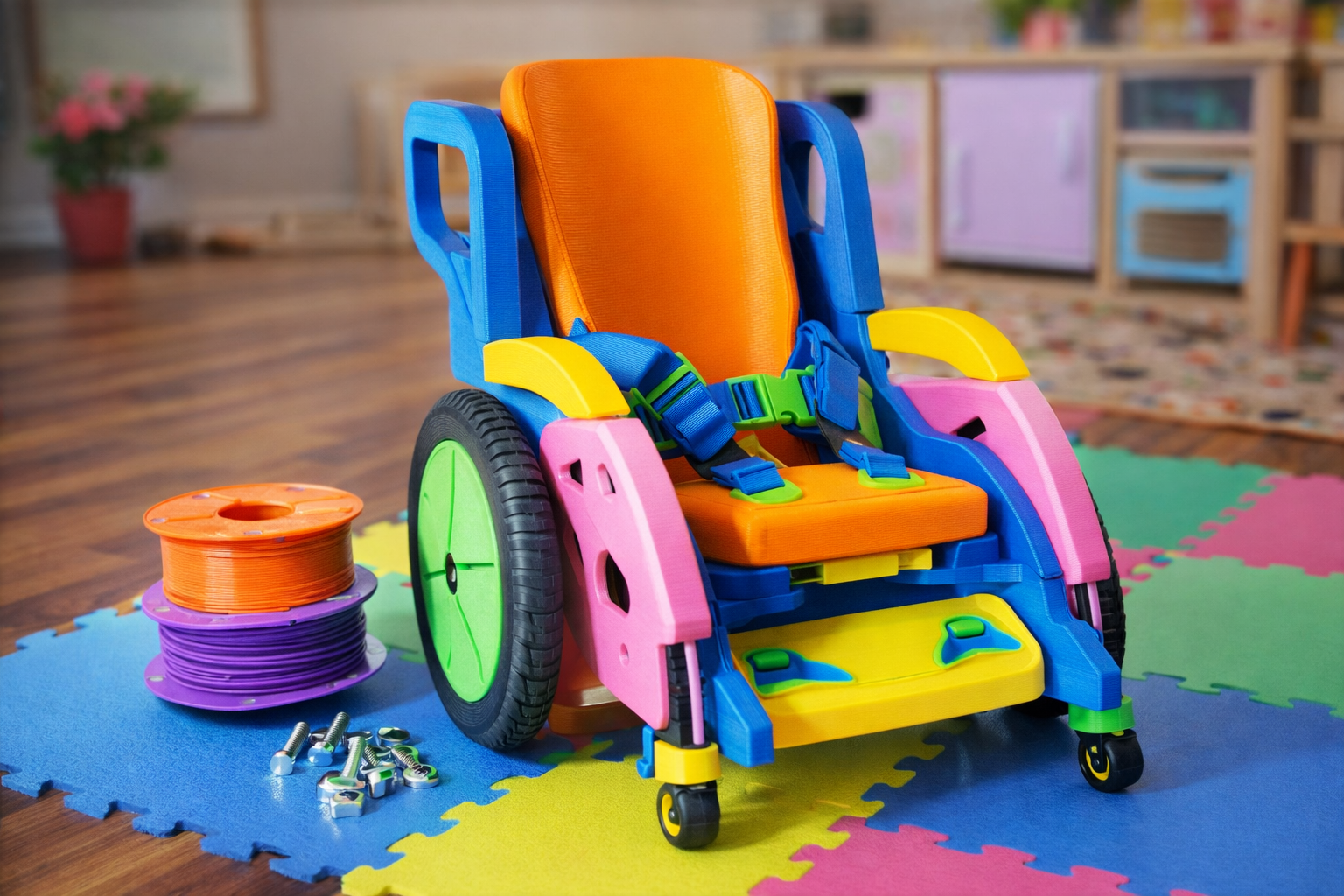
Makers print the device using PETG and TPU, two materials known for durability, flexibility, and practical day-to-day use. According to MakeGood, the design has gone through extensive testing, and the multi-piece construction helps strengthen the finished build.
- Age range: 1–8 years old
- Weight capacity: up to 50 lbs
- Materials: PETG and TPU
- Safety features: 5-point harness system
- Use case: indoor use only under adult supervision
The TMT is a mobility trainer, not a certified medical device. Families should always consult their child’s pediatrician, physical therapist, or occupational therapist to make sure the device is appropriate for their child’s needs.
How We Hope to Build a 3D-Printed Mobility Trainer for Kids
Signing up is only the first step. Before we can take on a build, we still need to complete the approval process. MakeGood asks makers to share information about their equipment and experience, then complete a test print for quality verification.
To qualify, a maker needs a 3D printer with a minimum build volume of 256 × 256 × 256 mm. Popular printer brands that can handle this type of work include Bambu Lab, Prusa, Creality, and other machines capable of reliable long-duration prints.
Once a maker is approved, they can browse requests, choose a delivery radius, and claim a build that fits their location and capacity. That is the stage we hope to reach next.
What It Takes to Print a Mobility Trainer for Kids
This is not a quick weekend project. A full mobility trainer for kids is a serious volunteer build that takes time, material, consistency, and follow-through.
- Minimum printer size: 256 × 256 × 256 mm
- Total print time: approximately 200–250 hours
- Print plates: 24 total plates
- Filament required: about 9 kg of PETG and 2 kg of TPU
On a single printer, that can mean roughly two to three weeks of printing depending on speed, reliability, and day-to-day workflow. Makers with multiple printers can move faster, but it is still a substantial commitment.
If a request is fully sponsored, MakeGood coordinates a complete kit with the needed parts and materials. If a request is not fully sponsored, makers can source their own materials or order kits through Schoolhouse Spools. A full materials and parts kit is listed at around $100.
What Happens After the Build Is Finished
After a maker completes a TMT, MakeGood staff review the build before delivery. The maker must submit a set of required photos, including the front, left, right, rear, and harness view. Once the build is approved, the maker delivers the finished trainer to the specified drop-off location and marks it as delivered so the family receives pickup notification.
If something breaks later, the maker and the broader MakeGood community can often help with support, including reprinting parts if needed. That ongoing support is one of the things I respect most about the model. The goal is not just to drop off a device. The goal is to help families through a thoughtful community-driven process.
Why We’re Sharing This at the Start
Even though we are still waiting for approval, I wanted to document this from the beginning. Too often, people only see the finished result. I think there is real value in showing the full story behind a mobility trainer for kids, from sign-up and approval to test prints, build selection, printing, assembly, and final delivery.
This post is the beginning of that series. If all goes well, the next updates will cover approval, our test prints, claiming a build, and the actual production workflow. I want to show the full process as it happens, not just the polished final version.
For me, that matters because the story behind a project like this is part of the point. It is not just about a finished chair. It is about using the equipment, time, and experience we already have to help another family move one step closer to something their child needs.
MakeGood Community Map
One of the things I like most about this program is that it is not abstract. There is a real network of vetted makers and families behind it. You can explore the live MakeGood community map below to see how broad that reach already is.
We’ll Keep Sharing the Journey
We are proud to have taken this first step, and we are hopeful that approval will lead to the chance to build a mobility trainer for kids who truly needs one.
As we move through the process, I will continue posting updates here on the site. That will include approval, printer prep, materials, test prints, build documentation, finished assembly, and whatever lessons we learn along the way.
This kind of work is a strong reminder that 3D printing can be about more than products. Sometimes it can be about service, support, and helping another family in a very real way.
